Can Faceless YouTube Channels Get Monetized in 2027?
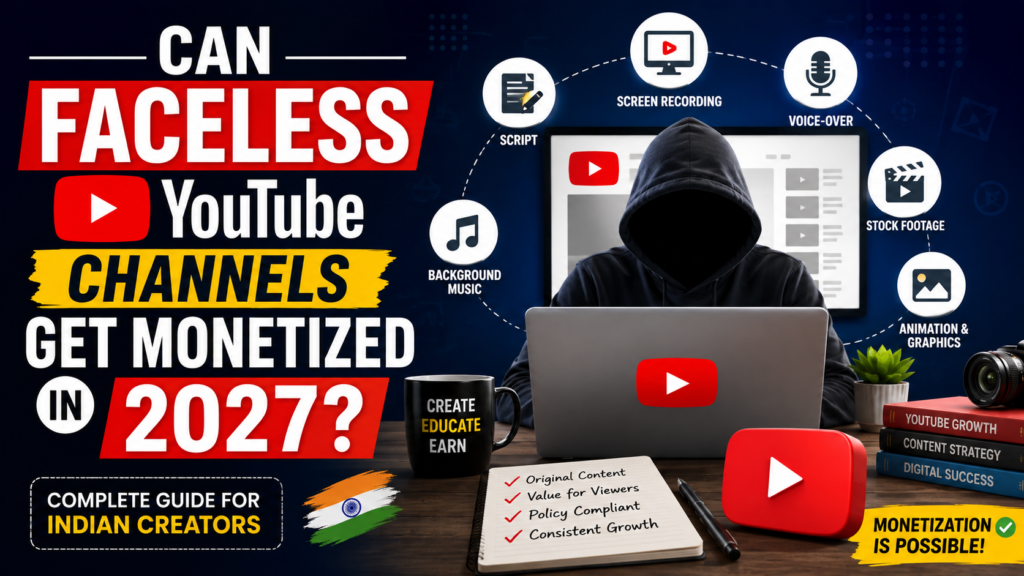
Quick Read: Can Faceless YouTube Channels Get Monetized in 2027?
Yes, faceless YouTube channels can get monetized in 2027. YouTube does not require creators to show their faces. The main focus is on creating original, authentic, useful, and valuable content.
Faceless creators can use voice-overs, screen recordings, animation, tutorials, storytelling, graphics, and AI tools. However, mass-produced, repetitive, copied, or low-value content can create monetization problems.
AI can be used as a tool for research, scripting, visuals, and editing, but creators should add their own ideas, creativity, commentary, and perspective.
For Indian creators, the best strategy is to focus on quality over quantity, create original content, avoid excessive automation, and follow YouTube’s latest monetization guidelines.
Want to learn digital marketing, YouTube marketing, and content creation? Join Vidya Sarthi, a marketing institute, and develop practical skills to grow your digital career.
Table of Contents
If you want to start a YouTube channel but do not want to appear on camera, you may be wondering: Can a faceless YouTube channel get monetized in 2027?
The short answer is yes. A YouTube channel does not have to show the creator’s face to be eligible for monetization. The important thing is not whether you show your face, but whether your content is original, authentic, useful, and follows YouTube’s monetization policies.
For Indian creators, faceless channels can be an interesting way to enter the world of content creation. You can create educational videos, tutorials, explainers, storytelling videos, product information, business content, animation, screen-recording tutorials, and many other types of videos without appearing on camera.
However, there is an important point to understand before starting.
YouTube currently does not have a separate official “2027 faceless channel monetization policy.” Its current monetization rules focus on original and authentic content and restrict content that is mass-produced, repetitive, generic, or reused without meaningful changes. YouTube clarified these rules in July 2025 by renaming its “repetitious content” policy as “inauthentic content.” (Google Help)
So, if you are planning a faceless channel for 2027, focus on the quality and originality of your content, not simply on hiding your face.
What Is a Faceless YouTube Channel?
A faceless YouTube channel is a channel where the creator does not appear on camera.
Instead of showing your face, you can use:
Voice-over
Screen recordings
Animation
Stock footage
Original graphics
Presentations
Product demonstrations
Tutorials
AI-assisted visuals
Storytelling
Video editing and motion graphics
For example, an Indian creator can start a faceless channel about digital marketing and explain SEO, social media marketing, Google Ads, or content creation using screen recordings, graphics, voice-over, and practical examples.
The creator’s face is not necessary.
What matters is the value the viewer receives from the video.
Can Faceless Channels Get Monetized?
Yes, a faceless channel can be monetized if it meets YouTube’s eligibility requirements and follows its monetization policies.
YouTube’s current rules say monetized content should be original and authentic. Content should not be mass-produced, generic, repetitive, or created mainly to get views. (Google Help)
This means there is no simple rule saying:
“Faceless channels cannot be monetized.”
Instead, YouTube looks at the content itself.
A faceless channel with original research, narration, editing, storytelling, education, or commentary can be very different from a channel that automatically produces hundreds of nearly identical videos.
What Does YouTube Check?
When reviewing a channel, YouTube may look at the channel as a whole. This can include its main theme, most-viewed videos, newest videos, videos contributing the most watch time, titles, thumbnails, descriptions, and the About section. (Google Help)
This is important for faceless creators.
You should not think only about individual videos. Your entire channel should show a clear purpose and consistent value.
For example, if your channel is about personal finance, your videos could explain:
How SIPs work
How to create a monthly budget
Common financial mistakes
Basic investing concepts
Tax-related concepts in simple language
Each video can follow a similar style, but the actual information and presentation should provide meaningful value.
What Type of Faceless Content Can Be Monetized?
Faceless content can work well when the creator brings something original to the video.
Some examples include:
1. Educational Videos
You can explain complicated subjects using voice-over, animations, diagrams, screen recordings, or presentations.
For example, a channel can teach English speaking, digital marketing, coding, mathematics, or career skills.
2. Tutorials
Screen-recording tutorials are naturally suited to faceless channels.
You can show viewers how to use software, websites, editing tools, marketing platforms, or other digital products.
3. Original Storytelling
Storytelling channels can use narration, original scripts, visuals, animation, and sound design.
The important part is creating a meaningful and original story instead of simply copying stories from other websites.
4. Commentary and Analysis
You can create videos explaining trends, businesses, technology, sports, or other topics.
If you use outside material, add meaningful commentary, analysis, editing, or educational value. YouTube allows transformed reused content in some cases when viewers can clearly see a meaningful difference from the original. (Google Help)
5. Screen-Based Content
Channels that teach software, websites, editing, design, coding, or digital marketing can work without showing the creator’s face.
Your screen becomes the main visual element while your voice explains the process.
What Faceless Content Can Cause Monetization Problems?
This is where many new creators make mistakes.
A faceless channel can have problems if its videos look mass-produced or repetitive.
YouTube specifically gives examples of content that may not be eligible for monetization, including repetitive videos with little educational value or commentary, templated storylines, image slideshows with little or no narrative, and AI-generated videos made with generic templates that appear to be mass-produced. (Google Help)
For example, imagine a channel uploading:
“10 Facts About India”
Then another video:
“10 Facts About America”
Then another:
“10 Facts About Japan.”
If every video uses the same template, same narration style, similar visuals, and provides little original value, the channel may face problems.
The issue is not that the channel is faceless.
The issue is that the content may appear repetitive and mass-produced.
What About AI Faceless YouTube Channels?
AI is one of the biggest topics for faceless creators.
Many creators now use AI for:
Research
Script ideas
Voice generation
Video editing
Images
Animation
Captions
Background visuals
Using AI does not automatically make a channel ineligible for monetization.
YouTube has stated that creators can use AI tools to enhance storytelling, and channels using AI can remain eligible for monetization if they follow the relevant policies. YouTube’s guidance also emphasizes that the final content should demonstrate the creator’s creative vision and provide educational or entertainment value. (Google Help)
So, think of AI as a tool, not a replacement for originality.
Instead of asking AI to create 100 similar videos and uploading them automatically, use AI to help you create better research, scripts, visuals, or editing—and then add your own ideas and perspective.
What About Reused Content?
Reused content is another important area for faceless creators.
YouTube defines reused content as content that repurposes material already available on YouTube or another online source without significant original commentary, substantive modifications, or educational or entertainment value. (Google Help)
For example, simply downloading clips from Instagram, adding background music, and uploading them to YouTube is risky.
Similarly, reading articles or news feeds word-for-word over stock footage can create monetization problems when the creator has not added meaningful original value. (Google Help)
A better approach is to research a topic, understand it, create your own script, explain it in your own way, and use visuals that support your original presentation.
How Can You Make a Faceless Channel Monetization-Friendly?
If you want to build a faceless channel for 2027, follow these simple practices.
1. Create Original Scripts
Do not simply copy articles, videos, or social media posts.
Research your topic and create your own explanation.
2. Add Your Own Voice and Perspective
Your voice does not necessarily mean showing your face.
Your opinions, examples, experiences, analysis, and storytelling style can make the content more original.
3. Avoid Mass Production
Uploading 10 low-quality videos every day is not necessarily better than creating two useful videos every week.
Focus on quality.
4. Make Every Video Valuable
Ask yourself:
“What will the viewer learn, understand, or enjoy after watching this video?”
If you cannot answer this question, improve the video before publishing it.
5. Be Careful With Stock Footage
Stock footage can support your video, but it should not be the entire value of your content.
Use visuals to support your original narration and ideas.
6. Use AI Responsibly
AI can help you work faster, but your final video should still have a clear creative direction.
If realistic content is altered or synthetically generated in ways that require disclosure, follow YouTube’s applicable disclosure requirements. (Google Help)
What Are the YouTube Monetization Requirements?
For ad revenue, YouTube currently requires a channel to reach 1,000 subscribers and either 4,000 valid public watch hours in the past 12 months or 10 million valid public Shorts views in the past 90 days. Meeting these numbers does not automatically guarantee approval; YouTube reviews the channel for policy compliance. (Google Help)
There is also an expanded YPP entry level in eligible regions, with lower thresholds for features such as fan funding and Shopping. The exact features available depend on eligibility and location. (Google Help)
Therefore, reaching the subscriber and view targets is only one part of monetization.
Final Answer: Can Faceless Channels Get Monetized in 2027?
Yes, faceless YouTube channels can get monetized, provided they meet YouTube’s eligibility requirements and follow its monetization policies.
There is currently no official rule saying that a creator must show their face to earn money from YouTube.
The real focus is on originality, authenticity, viewer value, and meaningful content.
For Indian creators, this creates a great opportunity. You can start a channel from your home with a laptop, microphone, editing software, and a good content idea. You do not need an expensive camera or studio.
But remember: faceless does not mean effortless.
A successful faceless channel still needs research, creativity, good storytelling, editing, consistency, and an understanding of the audience.
As YouTube’s policies continue to evolve, creators planning for 2027 should regularly check the latest official YouTube guidelines instead of relying on social media rumours.
Conclusion
Faceless YouTube channels are not automatically excluded from monetization. The key is to build a channel that gives viewers something original, useful, educational, or entertaining.
Avoid copied videos, repetitive templates, low-value slideshows, and mass-produced content. Use AI and other tools to improve your production process, but keep your own creativity and value at the centre of every video.
If you are planning to start a faceless YouTube channel in 2027, start building the right skills today.
CTA
Want to learn digital marketing, content creation, YouTube marketing, and other practical digital skills? Join Vidya Sarthi, a marketing institute, and learn how to build and grow your digital presence with the right knowledge and strategy.
Start learning, start creating, and turn your ideas into valuable content.